We saw in the previous section that if
\(\left(f_n\right)\) is a sequence of continuous functions which converges uniformly to
\(f\) on an interval, then
\(f\) must be continuous on the interval as well. This was not necessarily true if the convergence was only pointwise. For example, we saw in
equation (11.1.1) a sequence of continuous functions defined on
\((-\infty,\infty)\) converging pointwise to a function that was not continuous on
\((-\infty,\infty)\text{.}\) Uniform convergence guarantees some other nice properties as well.
Theorem 11.2.1.
Problem 11.2.2.
Hint.
For
\(\eps>0,\) we need to make
\(|f_n(x)-f(x)|\lt
\frac{\eps}{b-a},\) for all
\(x\in[a,b]\text{.}\)
Notice that this theorem is not true if the convergence is only pointwise, as illustrated by the following.
Problem 11.2.3.
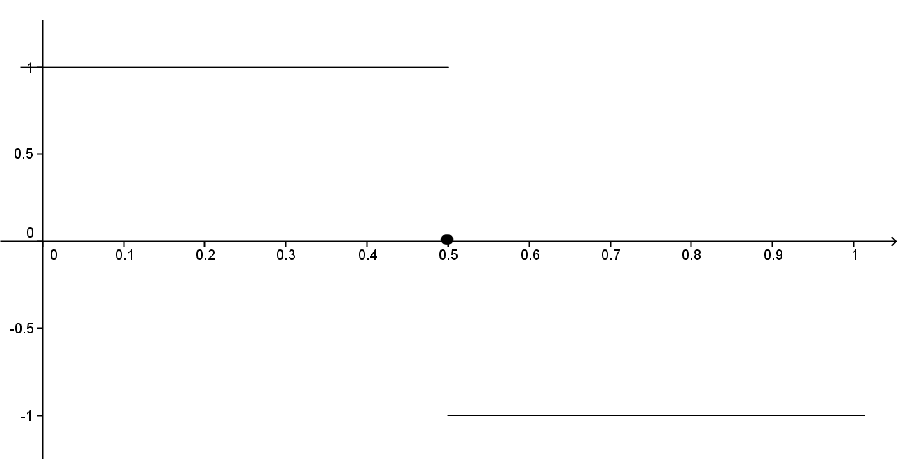
Consider the sequence of functions \(\left(f_n\right)\) given by
\begin{equation*}
f_n(x)= \begin{cases}n\amp \text{ if } x\in\left(0,\frac{1}{n}\right)\\ 0\amp \text{ otherwise } \end{cases} \text{.}
\end{equation*}
(a)
Show that \(f_n\ptwise 0\) on \([0,1],\) but
\begin{equation*}
\limit{n}{\infty}{\left( \int_{x=0}^1f_n(x)\dx{
x}\right) \neq\int_{x=0}^10\dx{ x}}\text{.}
\end{equation*}
(b)
Can the convergence be uniform? Explain.
Applying the result of
Problem 11.2.3 to power series we have the following.
Corollary 11.2.4.
If \(\sum_{n=0}^\infty a_nx^n\) converges uniformly to \(f\) on an interval containing \(0\) and \(x\) then
\begin{equation*}
\int_{t=0}^xf(t)\dx{
t}=\sum_{n=0}^\infty\left(\frac{a_n}{n+1}x^{n+1}\right)\text{.}
\end{equation*}
(Notice that we must explicitly assume uniform convergence. This is because we have not yet proved that power series actually do converge uniformly.)
Problem 11.2.5.
Hint.
Remember that
\begin{equation*}
\displaystyle \sum_{n=0}^\infty f_n(x) =
\limit{N}{\infty}{\left(\sum_{n=0}^N f_n(x)\right)}.
\end{equation*}
Surprisingly, the issue of term–by–term differentiation depends not on the uniform convergence of
\(\left(f_n\right),\) but on the uniform convergence of
\(\left(f^\prime_n\right)\text{.}\) More precisely, we have the following result.
Theorem 11.2.6.
Problem 11.2.7.
Hint.
Let \(a\) be an arbitrary fixed point in \(I\) and let \(x\in I\text{.}\) By the Fundamental Theorem of Calculus, we have
\begin{equation*}
\int_{t=a}^x f^\prime_n(t)\dx{t}=f_n(x)-f_n(a) \text{.}
\end{equation*}
Take the limit of both sides and differentiate with respect to \(x\text{.}\)
Corollary 11.2.8.
Problem 11.2.9.
Taken together the above results say that a power series can be differentiated and integrated term–by–term as long as the convergence is uniform. Fortunately it is in general true that when a power series converges the convergence of it and its integrated and differentiated series is also (almost) uniform.
However we do not yet have all of the tools necessary to see this. To build these tools requires that we return briefly to our study, begun in
Chapter 6, of the convergence of sequences.
Subsection 11.2.1 Cauchy Sequences
Knowing that a sequence or a series converges and knowing what it converges to are typically two different matters. For example, we know that
\(\sum_{n=0}^\infty\frac{1}{n!}\)and
\(\sum_{n=0}^\infty\frac{1}{n!\,n!}\) both converge. The first converges to
\(e,\) which has meaning in other contexts. We don’t know what the second one converges to, other than to say it converges to
\(\sum_{n=0}^\infty\frac{1}{n!\,n!}\text{.}\) In fact, that question might not have much meaning without some other context in which
\(\sum_{n=0}^\infty\frac{1}{n!\,n!}\) arises naturally. Be that as it may, we need to look at the convergence of a series (or a sequence for that matter) without necessarily knowing what it might converge to. We make the following definition.
Definition 11.2.10. Cauchy Sequence.
Let
\(\left(s_n\right)\) be a sequence of real numbers. We say that
\(\left(s_n\right)\)is a
Cauchy sequence if for any
\(\eps>0,\) there exists a real number
\(N\) such that if
\(m,n>N,\) then
\(|s_m-s_n|\lt \eps\text{.}\)
Notice that this definition says that the terms in a Cauchy sequence get arbitrarily close to each other and that there is no reference to getting close to any particular fixed real number. Furthermore, you have already seen lots of examples of Cauchy sequences as illustrated by the following result.
Theorem 11.2.11.
Suppose
\(\left(s_n\right)\) is a sequence of real numbers which converges to
\(s\text{.}\) Then
\(\left(s_n\right)\) is a Cauchy sequence.
Intuitively,
Theorem 11.2.11 makes sense. If the terms of a sequence are getting arbitrarily close to
\(s\text{,}\) then they should be getting arbitrarily close to each other as well. This is the basis of the proof.
Problem 11.2.12.
Hint.
\(\abs{s_m-s_n}=\abs{s_m-s+s-s_n}\leq \abs{s_m-s}+\abs{s-s_n}\text{.}\)
So any convergent sequence is automatically Cauchy. For the real number system, the converse is also true and, in fact, is equivalent to any of our completeness axioms: the
NIP, the
Bolzano–Weierstrass Theorem, or the
LUB Property. Thus, this could have been taken as our completeness axiom and we could have used it to prove the others. One of the most convenient ways to prove this converse is to use the Bolzano–Weierstrass Theorem. To do that, we must first show that a Cauchy sequence must be bounded. This result is reminiscent of the fact that a convergent sequence is bounded (
Lemma 6.2.7 of
Chapter 6) and the proof is very similar.
Lemma 11.2.13.
Suppose
\(\left(s_n\right)\) \(\)is a Cauchy sequence. Then there exists
\(B>0\) such that
\(\abs{s_n}\leq B\) for all
\(n\text{.}\)
Problem 11.2.14.
Hint.
This is similar to
Problem 6.2.8 of
Chapter 6. There exists
\(N\) such that if
\(m,n>N\)then
\(|s_n-s_m|\lt
1\text{.}\) Choose a fixed
\(m>N\) and let
\(B=\max\left(\abs{s_1}, \abs{s_2}, \ldots,
\abs{s_{\lceil N\rceil}}, \abs{s_m}+1\right)\text{.}\)
Theorem 11.2.15. Cauchy Sequences Converge in \(\RR \).
Suppose \(\left(s_n\right)\) is a Cauchy sequence of real numbers. There exists a real number \(s\) such that
\begin{equation*}
\limit{n}{\infty}{s_n}=s\text{.}
\end{equation*}
Sketch of Proof.
We know that \(\left(s_n\right)\) \(\)is bounded, so by the Bolzano–Weierstrass Theorem, it has a convergent subsequence \(\left(s_{n_k}\right)\) converging to some real number \(s\text{.}\) We have
\begin{equation*}
\abs{s_n-s}=\abs{s_n-s_{n_k}+s_{n_k}-s}\leq
\abs{s_n-s_{n_k}}+\abs{s_{n_k}-s}\text{.}
\end{equation*}
If we choose \(n\) and \(n_k\) large enough, we should be able to make each term arbitrarily small.
Problem 11.2.16.
From
Theorem 11.2.15 we see that every Cauchy sequence converges in
\(\RR\text{.}\) Moreover the proof of this fact depends on the
Bolzano–Weierstrass Theorem which, as we have seen, is equivalent to our completeness axiom, the
Nested Interval Property. What this means is that if there is a
Cauchy sequence which does not converge then the
NIP is not true. A natural question to ask is if every Cauchy sequence converges does the NIP follow? In other words, is the convergence of Cauchy sequences also equivalent to our completeness axiom? The following theorem shows that the answer is yes.
Theorem 11.2.17.
Problem 11.2.18.
Hint.
If we start with two sequences
\(\left(x_n\right)\) and
\(\left(y_n\right)\text{,}\) satisfying all of the conditions of the
NIP, you should be able to show that these are both Cauchy sequences.
Taken together
Problem 11.2.16 and
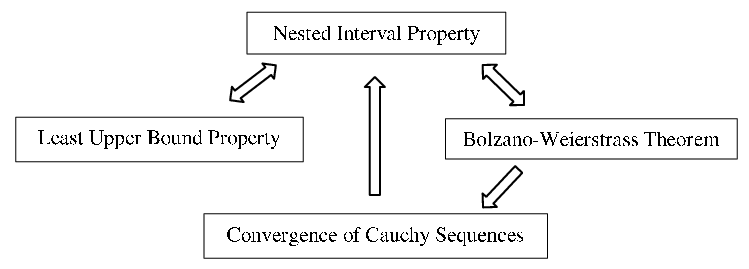
Problem 11.2.18 tell us that the following are equivalent: the Nested Interval Property, the Bolzano–Weierstrass Theorem, the Least Upper Bound Property, and the convergence of Cauchy sequences. Thus any one of these could have been taken as the completeness axiom of the real number system and then used to prove the each of the others as a theorem according to the following dependency graph:
Since we can get from any node on the graph to any other, simply by following the implications (indicated with arrows), any one of these statements is logically equivalent to each of the others.
Problem 11.2.19.
Since the convergence of Cauchy sequences can be taken as the completeness axiom for the real number system
\((\RR)\text{,}\) it does not hold for the rational number system
\((\QQ)\text{,}\) since
\(\QQ{}\) is not complete. Give an example of a Cauchy sequence of rational numbers which does not converge to a rational number.
If we apply the above ideas to series we obtain the following important result, which will provide the basis for our investigation of power series.
Theorem 11.2.20. Cauchy Criterion.
The series \(\sum_{k=0}^\infty a_k\) converges if and only if \(\forall\) \(\eps>0\text{,}\) \(\exists\ N\) such that
\begin{align*}
\text{if } m\gt{}n\gt{}N\amp{}\amp{}\text{ then }\amp{}\amp{} \abs{\sum_{k=n+1}^ma_k}\lt
\eps.
\end{align*}
Problem 11.2.21.
Prove the Cauchy criterion.
At this point several of the convergence tests that you probably saw in Calculus are easily proved.
Problem 11.2.22. The \(n\)th Term Test.
Show that if
\(\sum_{n=1}^\infty a_n\) converges then
\(\limit{n}{\infty}{a_n}=0\text{.}\)
Problem 11.2.23. The Strong Cauchy Criterion.
Show that
\(\displaystyle\sum_{k=1}^\infty a_k\) converges if and only if
\(\limit{n}{\infty}{\sum_{k=n+1}^\infty a_k}=0\text{.}\)
Hint.
The hardest part of this problem is recognizing that it is really about the limit of a sequence as in
Chapter 6.
You may also recall the
Comparison Test from your study of series in Calculus. The result follows from the fact that for a series
\(\sum a_n \) with non–negative terms the partial sums of
\(\sum a_n\) form an increasing sequence which is bounded above by
\(\sum b_n\text{.}\) (See
Corollary 9.4.5 of
Chapter 9.) The
Cauchy Criterion allows us to extend this to the case where the terms
\(a_n\) could be negative as well. This can be seen in the following theorem.
Theorem 11.2.24. Comparison Test.
Suppose
\(|a_n|\leq b_n\) for all
\(n\text{.}\) If
\(\sum
b_n\) converges then
\(\sum a_n\) also converges.
Problem 11.2.25.
Hint.
Use the Cauchy criterion with the fact that
\(\abs{\sum_{k=n+1}^ma_k}\leq\sum_{k=n+1}^m\abs{a_k}\text{.}\)
The following definition is of fundamental importance in the study of series.
Definition 11.2.26. Absolute Convergence.
Given a series
\(\sum a_n\text{,}\) the series
\(\sum|a_n|\) is called the
absolute series of
\(\sum a_{n}\) and if
\(\sum|a_n|\) converges then we say that
\(\sum a_{n}\) converges absolutely.
The significance of this definition comes from the following result.
Corollary 11.2.27.
If
\(\sum a_n\) converges absolutely, then
\(\sum a_n\) converges.
Problem 11.2.28.
Problem 11.2.29.
If
\(\displaystyle\sum_{n=0}^\infty\abs{a_n}=s\text{,}\) does it follow that
\(\displaystyle s= \abs{\sum_{n=0}^\infty a_n}\text{?}\) Justify your answer. What can be said?
The converse of
Corollary 11.2.27 is not true as evidenced by the series
\(\displaystyle\sum_{n=0}^\infty\frac{(-1)^n}{n+1}\text{.}\) As we noted in
Chapter 4, this series converges to
\(\ln 2\text{.}\) However, its absolute series is the Harmonic Series which diverges. Any such series which converges, but not absolutely, is said to
converge conditionally. Recall also that in
Chapter 4, we showed that we could rearrange the terms of the series
\(\displaystyle\sum_{n=0}^\infty\frac{(-1)^n}{n+1}\) to make it converge to any number we wished. We noted further that all rearrangements of the series
\(\displaystyle\sum_{n=0}^\infty\frac{(-1)^n}{\left(n+1\right)^2}\) converged to the same value. The difference between the two series is that the latter converges absolutely whereas the former does not. Specifically, we have the following result.
Theorem 11.2.30.
Suppose \(\sum a_n\) converges absolutely and let
\begin{equation*}
s=\sum_{n=0}^\infty a_n\text{.}
\end{equation*}
Then any rearrangement of \(\sum a_n\) must converge to \(s\text{.}\)
Sketch of Proof.
We will first show that this result is true in the case where
\(a_n\geq 0\text{.}\) If
\(\sum b_n\) represents a rearrangement of
\(\sum a_n\text{,}\) then notice that the sequence of partial sums
\(\displaystyle\left(\sum_{k=0}^nb_k\right)_{n=0}^\infty\)is an increasing sequence which is bounded by
\(s\text{.}\) By
Corollary 9.4.5 of
Chapter 9, this sequence must converge to some number
\(t\) and
\(t\leq s\text{.}\) Furthermore
\(\sum a_n\) is also a rearrangement of
\(\sum b_n\text{.}\) Thus the result holds for this special case. (Why?) For the general case, notice that
\(a_n=\frac{|a_n\mathopen|+a_n}{2}-\frac{|a_n\mathopen|-a_n}{2}\) and that
\(\sum\frac{|a_n\mathopen|+a_n}{2}\) and
\(\sum\frac{|a_n\mathopen|-a_n}{2}\) are both convergent series with non–negative terms. By the special case
\begin{align*}
\sum\frac{\abs{b_n}+b_n}{2}=
\sum\frac{\abs{a_n}+a_n}{2}\amp{}\amp{}\text{ and }\amp{}\amp{}
\sum\frac{\abs{b_n}-b_n}{2}=
\sum\frac{\abs{a_n}-a_n}{2}.
\end{align*}
Problem 11.2.31.